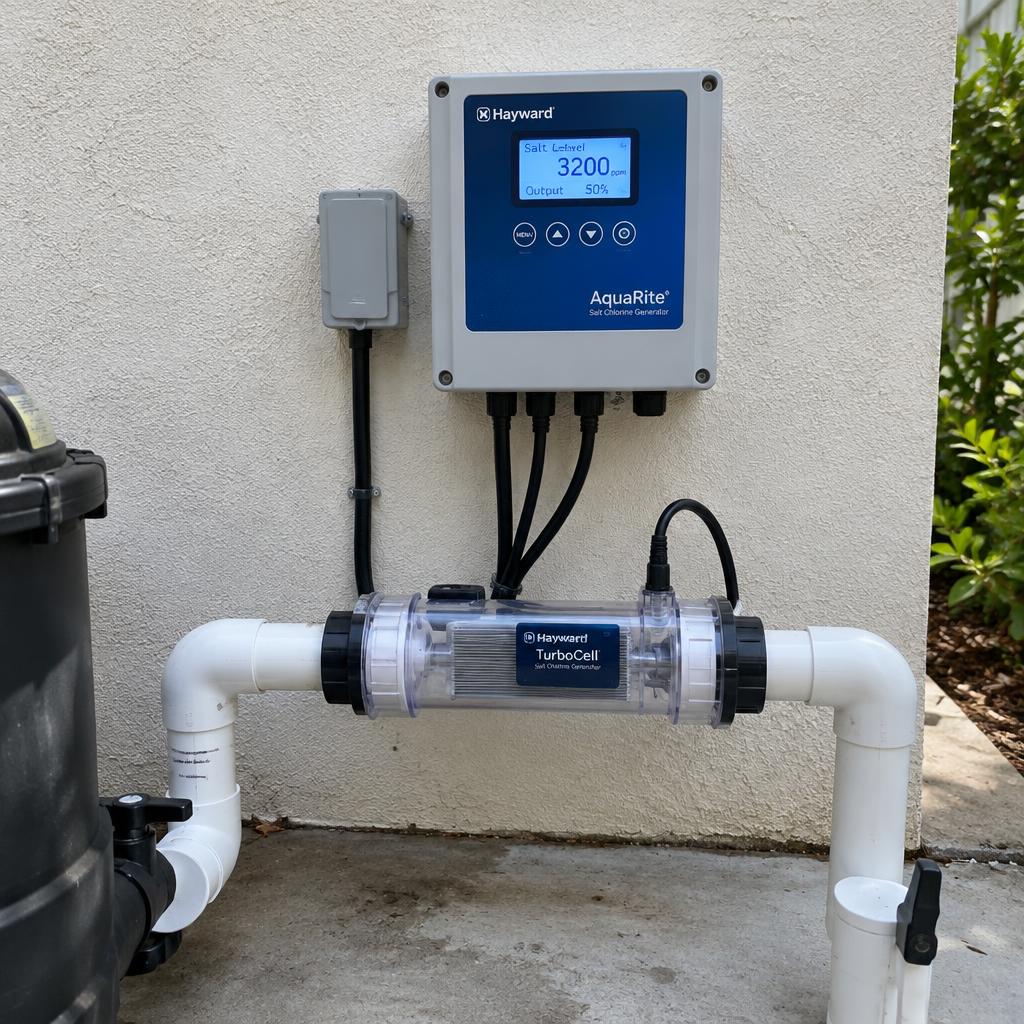
1Look at the control panel: note salt reading, output %, and any warning lights (low salt, high salt, no flow, check cell).
2Test salt with salt test strips or a digital meter. Compare with the range in your generator manual — many models run around 2,700–3,400 ppm, but your model's range wins.
3Confirm water flow: the pump must be running and the flow switch must detect flow before the cell produces chlorine.
4Test free chlorine in the pool. If it's low while the generator reads normal, raise output % or run time per the manual, and check stabilizer (CYA) levels.
5Inspect the cell. White scale on the plates reduces production. Clean it only by the method and frequency in your equipment manual.
Control box and inline cell. Demonstration image.
Recovering a green salt pool
A generator usually can't produce chlorine fast enough to clear an algae bloom. Most manufacturers recommend adding a compatible chlorine product directly for recovery — check your manual.
Follow Steps 1–7 of the method. Keep the generator running per its manual.
Salt pools tend to drift toward high pH. Test pH often.
Weekly salt pool checklist
Turn power off at the panel before touching the cell or wiring. Cell acid-cleaning, if your manual calls for it, must follow the manual exactly — never add acid to the pool and the cell at the same time.